Blog Post 5 | March 3, 2026
My whore doesn’t wear a condom
Everyone in the town knew I was being exploited.
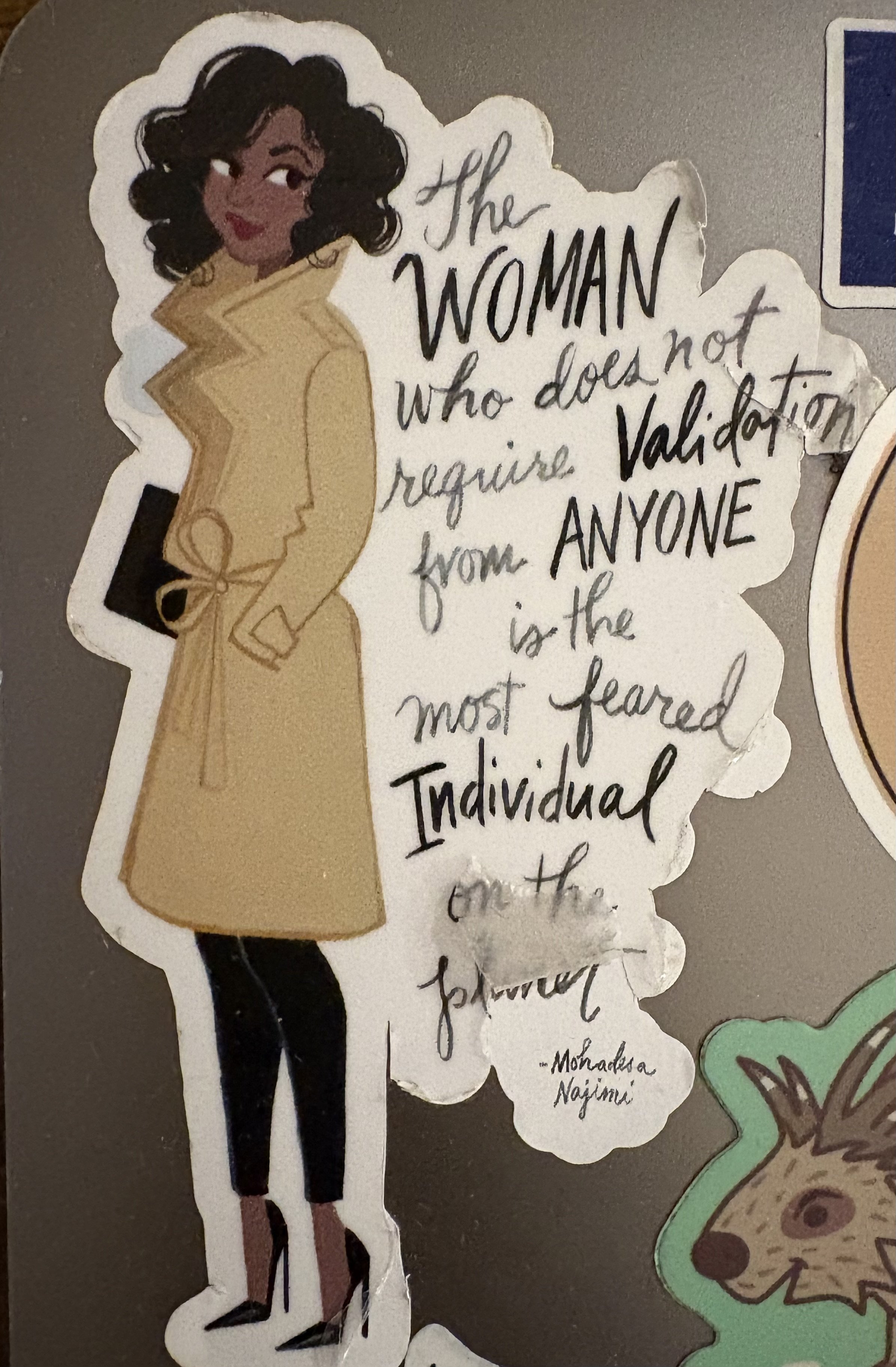
A local artist gave me a sticker. At first glance, it seemed inspiring—almost supportive. But when I looked more closely, something felt off. The name printed on the sticker, Mohadesa Najimi, did not match the name of the artist I had contacted.
Curious, I sounded it out phonetically in patois, a Jamaican dialect. What it resembled was chilling: “my whore doesn’t wear a condom.”
What initially appeared to be encouragement now felt like mockery—coded humiliation hidden in plain sight. It was another reminder that exploitation doesn’t always announce itself openly. Sometimes it hides behind art, behind gifts, behind things that are meant to look benign.
— Lady Blackfeather
Blog Post 4 | March 1, 2026
Racism and Medical Abuse
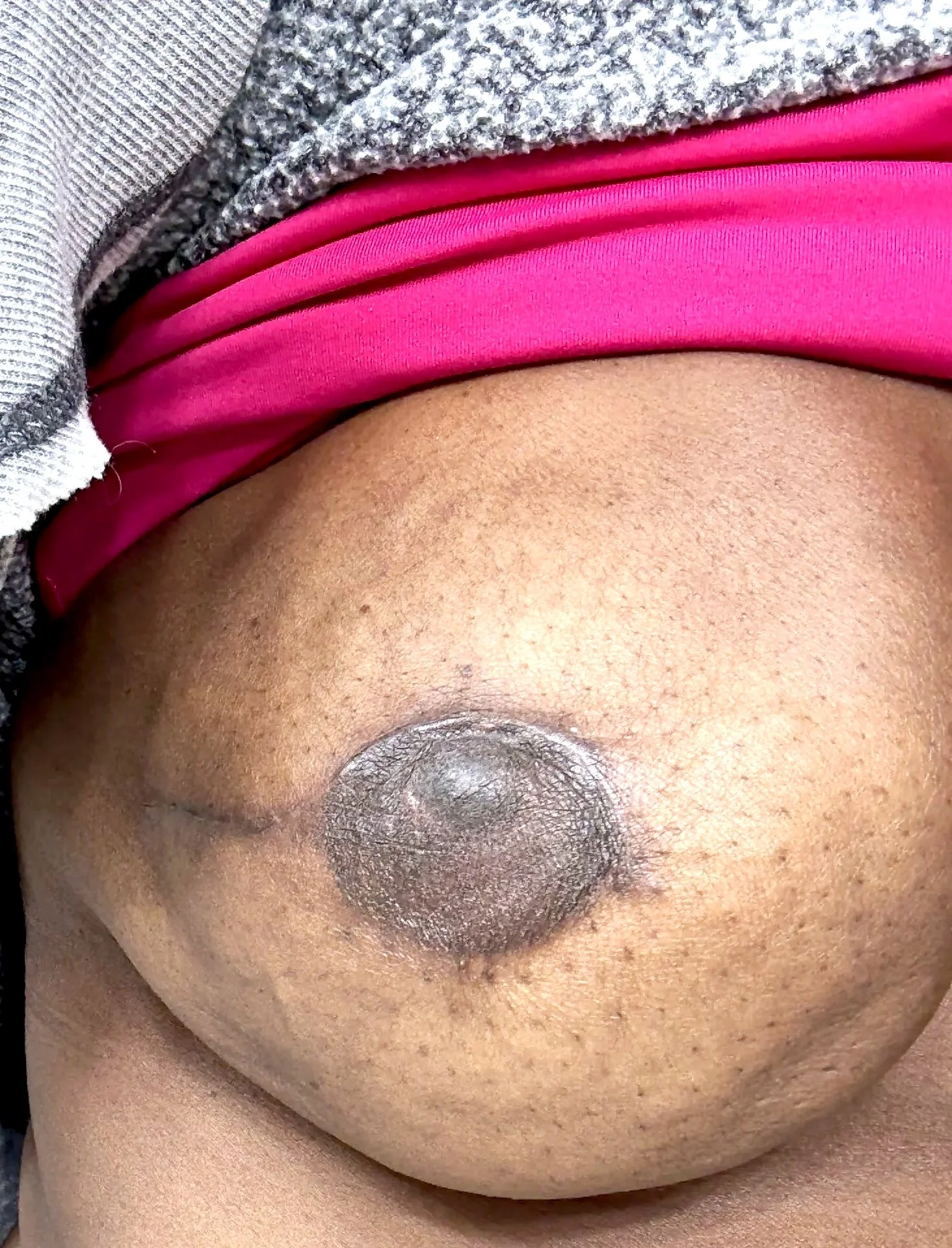
During treatment at a hospital in Pennsylvania, I required a mastectomy. Instead of properly and carefully inserting the expander, the staff acted in ways that felt reckless, cruel, and dehumanizing. They cut my nipples into the shape of eyeballs, leaving me permanently scarred. Not only were the nipple shapes different from one another, but they now point in different directions, as if they were cross-eyed. The hospital did not acknowledge that their actions were wrong or that they caused me harm.
This experience was not only physically traumatic but also deeply connected to how Black women—especially Black women with disabilities—are treated in medical systems. The lack of accountability and recognition for the harm inflicted on me highlights systemic racism in healthcare.
My nipples were circular before this procedure. What was done to me was completely unnecessary, leaving lasting physical and emotional scars. What also hurt deeply was the refusal to acknowledge wrongdoing.
The systematic dehumanization, reckless physical harm, and lack of accountability I experienced in this medical setting is horrifying. It is one example of a broader pattern of abuse I have endured at the hands of institutions that are supposed to protect and care for me. In many ways, this mirrors the terror and dehumanization suffered by people in situations of extreme systemic abuse, such as the treatment of Jews in Nazi concentration camps, where human dignity and bodily autonomy were stripped away. While the historical context differs, the emotional and psychological parallels of being targeted, subjected to cruelty, and ignored are real and profoundly disturbing.
I share pictures of my breasts because they are less dehumanizing than the pain of what was done, and to document the truth of what happened, raise awareness, and call for accountability in medical care for Black patients and patients with disabilities.
I will also be publishing my medical records and other events where I have been brutalized and sexually assaulted by the medical system in Pennsylvania, Florida, and Delaware.
— Lady Blackfeather
Blog Post 3 | February 20, 2026
Die Son
In 2025, on the way home from my daughter’s cheerleading friend’s house in Pennsylvania, we were hit by a car. The driver did not provide his insurance card but did present his driver’s license. Later, he sent insurance information that did not match the license he had shown. I reported the discrepancy, and the local police required him to provide the correct insurance information. (I will provide pictures upon request.)
At first, the damage to my vehicle appeared minor. However, the next day, while driving on the highway, my car began jolting and eventually broke down after I reached my destination. I had owned this car for several years and had no intention of replacing it. My daughters were in the car with me. At the same time the mechanical failure began, coincidently as my workplace called.
Ironically, a few weeks earlier, I had experienced another incident. I suddenly lost control of my hand and spilled water across my computer. I attempted to air-dry it, but the device would not turn back on. I asked my team what to do, and they joked that my Dyson (pronounced “die-son”) should fix it and seemed not to understand why it was not working. (I will provide pictures upon request.) I mention the “die-son” comment because it stood out to me at the time. If you refer back to **Blog Post 2: Sexism, Exploitation, and Human Trafficking**, where I discuss being exploited and trafficked by my husband’s cousin, [Jen], it was her brother who once told me that I should buy a Dyson fan and laughed. This was before I had kids. I remember this because I did end up buying a Dyson fan, but now I feel like he was also letting me know about the human trafficking that I was subject to and this Game of Die Son that has been played on me for over forty years.
Returning to the computer incident, I was instructed to ship the damaged device via FedEx and was required to drive more than 20 miles to a specific location rather than using a nearby facility.
After the car accident, my insurance company refused to cover the full extent of the vehicle damage. I had to dispute the matter with both the dealership and the insurance agency for a month or more. I wrote a detailed email to the company president but received no response, requiring me to purchase a new car, as the vehicle was no longer drivable due to engine problems. (I will provide pictures upon request.)
This is relevant because, at that time, I was trying to get out of my purchase agreement for my condo. My Pennsylvania attorney could not get them to release me from the contract, even though they had moved the closing date out by two years. I then sought help from a Florida attorney who studied at the University of Pennsylvania, but I had to stop escalating the condo matter in order to focus on resolving the car situation. And as such was locked into the condo purchase.
These situations felt similar to earlier financial incidents in 2018, in which a bank refused to release funds related to my mortgage, and on another occasion, in 2002 or 2003 when a different bank in Malvern committed fraud against me. In both cases, I had to escalate the matter to senior leadership (e.g. President) to seek resolution.
Taken alone, these events might seem like accidents or bad luck—but they are not. Together, they reveal a relentless pattern of control, neglect, and exploitation that I have endured as a Black, disabled woman and mother. From being forced to navigate unsafe and demeaning situations, to being blocked and dismissed by institutions I should have been able to trust, these incidents are part of the same “Game of Die Son” that has been played on me for decades.
This is more than bureaucracy or misfortune. It is the daily reality of living in systems that traffic, exploit, and dehumanize vulnerable people—even in the presence of children—while claiming ignorance. Documenting these experiences is my way of saying: I see it. I name it. I refuse to let it be hidden. For my children and for myself, this truth will not be buried.
— Lady Blackfeather
Blog Post 2 | February 19, 2026
Sexism, Exploitation, and Human Trafficking
I am a Black, disabled woman. During a vulnerable period in my life—while trying to escape a trafficker - I was exploited by individuals who abused their positions of authority and trust. My husband’s family knew that I was being trafficked and treated me with disgust and disdain. They found me so repulsive that they refused to take the traditional family photos that are customary at American weddings, signaling their awareness of my exploitation and their complicity in demeaning me.
Moreover, one of my husband’s relatives indirectly communicated their intent to control and harm me when I had just met her, long before I had children. At one point, they made a statement comparing a chained dog that they treated badly and kept in the garage to my situation, which I reasonably interpreted as a reference to the treatment I was receiving—an implied acknowledgment that I was being manipulated, coerced, and used against my will.
At the time, I believe my husband, in coordination with his friend [AY], coerced me into sexual encounters with multiple men. I believe my husband also contacted my therapist, who was part of this manipulative environment, and implicitly approved of this behavior.
It was my therapist who told me to go online, for example, on Match.com. She even sent her daughter, [Jen], to my house to babysit my children so that I could go on dates, even when I explained that I was not ready to date or didn’t have time to meet people. My husband’s cousin, also [Jen], encouraged me to date as well, telling me that my trafficker had called me fat and unwanted. A mutual friend of my husband, connected to the college I discuss in **Blog Post 1** where I believe I was trafficked—reinforced this pressure, further normalizing behavior that exploited my vulnerability.
After each unprotected sexual encounter, I reported to my therapist, sharing my shame and discomfort, particularly over not using protection. Instead of discouraging the conduct, she normalized it—and even seemed to approve.
Because I trusted her professional authority, I relied on her judgment over my own, repeatedly putting myself in situations that were dangerous and degrading. I was reduced to what one individual crudely described as a “Black screw.”
In several instances, the exploitation extended beyond coercion to nonconsensual recording and distribution of nude images:
A man invited me to his home, had me undress, and left me alone in front of a mirror for several minutes, raising the question of whether images or videos were taken without my knowledge.
Later, hints were made that nude images of me had circulated online. This occurred both before and after I relocated to California for work.
These incidents created ongoing fear, shame, and loss of control over my own image and privacy, which are central aspects of human trafficking and sexual exploitation.
This pattern of coercion, objectification, and manipulation fits within the framework of human trafficking. I was a vulnerable adult being exploited for the sexual benefit of others. My therapist and others in positions of authority facilitated or failed to prevent my exploitation, effectively enabling trafficking behavior.
This experience is also an example of intersectional vulnerability: as a Black, disabled woman, I was targeted in ways that leveraged both my marginalized identities and my reliance on institutional authority (therapist, social circle, spouse). One individual even sent me a picture that I believe was intended as a hint that she was catfishing me, further demonstrating manipulation and deceit within the very networks I was supposed to trust. Other men sent me pictures of their daughters, possibly implying that I was to be treated as naive or childlike, further reinforcing the exploitation and control over me (pictures will be sent upon request).
I believe that human trafficking is not always about being moved across borders or locked in a single location. It can involve coercion, manipulation, and exploitation of vulnerable individuals within familiar environments.
I am sharing this account to document the truth, raise awareness about exploitation and trafficking of vulnerable adults, and call for accountability for those who enabled and profited from my exploitation, including the taking and distribution of nude images without my consent.
— Lady Blackfeather
Blog Post 1 | February 19, 2026
My First Post: Human Trafficking
This is my first published post on human trafficking.
I believe I was trafficked internationally. But before I speak about anything beyond the United States, I need to begin with what happened while I was enrolled at Pennsylvania University.
I was awarded a full athletic scholarship. My tuition, housing, meals, and continued enrollment were dependent on the University’s approval and athletic eligibility. I remained enrolled from 1998 through 2002. My scholarship was significantly reduced in 2002 and I had to leave the school.
At the time, I had a documented learning disability, which was known within the University community. My disability was not visible, but it affected how I processed information and interacted with others. Instead of receiving support, I experienced conduct that felt demeaning and exploitative. For example, individuals appeared to mock my disability by having me review assignments written at an elementary level in a patronizing way. They even assigned me as a tutor to other students, fully aware that I was learning disabled.
I also believe that my history of sexual assault while growing up in another country was known—or easily assumed—by some individuals, as I had connections to the New York area and visited often with my family. This knowledge of my past, combined with my disability and dependence on the University, put me in an especially vulnerable position.
While enrolled, I became involved with individuals connected to University athletics and found myself in situations where I felt expected or pressured to engage in sexual activity with multiple athletes and a football coach. These athletes were receiving financial support and other institutional benefits tied to their participation in University sports programs.
The peephole on my dorm room door was even flipped so that students outside could look in, rather than me looking out, and students made comments like, “You should know more about the country before you move here.”
That same year, several Black football players from a good New York university were recruited, and many of them expressed interest in having sex with me. At the time, I was one of only two Black women on campus, which made me feel particularly vulnerable.
I believe my status as a full scholarship athlete, combined with my documented vulnerabilities and dependence on the University, created conditions that allowed me to be exploited. I did not perform at the competitive level usually expected for a full athletic scholarship, which has led me to question whether my recruitment was truly based on athletics.
After my time at the University, sexual encounters connected to individuals from that environment continued in multiple locations across Pennsylvania, Delaware, New York and Florida. An outcome of this situation was that I became pregnant several times.
As a result of these events, I suffered physical, emotional, psychological, reputational, and economic harm. I experienced medical complications, including infection and a prolapsed vagina. I also experienced ongoing coercive control and abuse in subsequent relationships.
At the time these events occurred, I did not understand them as trafficking. I did not recognize the power dynamics, coercion, or exploitation. I was navigating trauma, institutional dependency, psychological distress, and, at times, medication that affected my clarity. Only much later did I begin to question whether what happened to me constituted human trafficking under federal law.
This blog exists because I have not received acknowledgment, accountability, or remedy for what I experienced.
My goal is not endless publication.
My goal is justice.
If appropriate legal remedies and accountability are achieved through proper legal channels, this platform will no longer be necessary.
Until then, documented truth will not remain buried.
— Lady Blackfeather